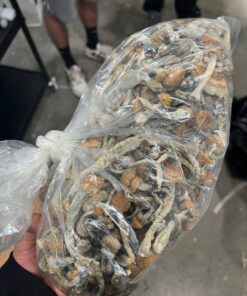
Complete Guide to Mushrooms: Ecological Roles, Culinary Types & Psilocybin Fungi
Mushrooms are the spore-bearing fruiting bodies of fungi, distinct from plants because they lack chlorophyll and do not perform photosynthesis. Instead, mushrooms absorb essential nutrients by breaking down organic matter in soil, decaying wood, or forming symbiotic relationships with plant root networks (mycorrhizae).
The kingdom Fungi includes millions of species spanning culinary delicacies, functional health species, psychoactive fungi, and lethal toxic wild mushrooms.
The 3 Major Functional Categories of Mushrooms
Fungi are broadly grouped according to their primary properties and human applications:
                            ┌── 1. CULINARY & NUTRITIONAL (Button, Shiitake, Portobello)
                            │
[Mushroom Categorization] ──┼── 2. MEDICINAL & FUNCTIONAL (Lion's Mane, Reishi, Chaga)
                            │
                            └── 3. PSYCHOACTIVE / PSILOCYBIN (Psilocybe cubensis, Liberty Caps)
1. Culinary Mushrooms (Nutritional Profile)
Edible mushrooms are low in calories and sodium while serving as rich sources of B vitamins (Niacin, Riboflavin), selenium, potassium, fiber, and antioxidants.
-
Button / Cremini / Portobello (Agaricus bisporus): The most widely cultivated edible mushroom worldwide across its various growth stages.
-
Shiitake (Lentinula edodes): Prized for its savory umami flavor profile and cardiovascular benefits.
-
Oyster Mushrooms (Pleurotus ostreatus): Fast-growing wood-decaying mushrooms rich in protein and essential minerals.
2. Functional & Medicinal Mushrooms
Non-intoxicating medicinal fungi contain high concentrations of beta-glucans (immunomodulatory polysaccharides) and bioactive compounds used in holistic health:
-
Lion’s Mane (Hericium erinaceus): Stimulates Nerve Growth Factor (NGF), supporting cognitive health, memory, and neurogenesis.
-
Reishi (Ganoderma lucidum): Known as the “Mushroom of Immortality,” used for stress adaptation and immune modulation.
-
Cordyceps (Cordyceps militaris): Enhances cellular energy ($ATP$ production) and oxygen utilization during physical exertion.
3. Psilocybin Mushrooms (“Magic Mushrooms”)
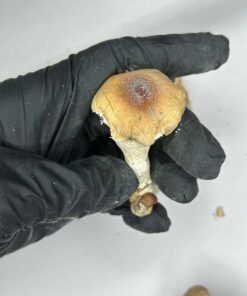
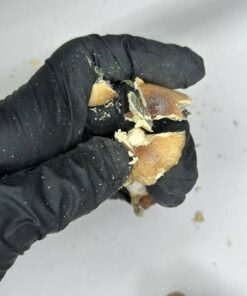
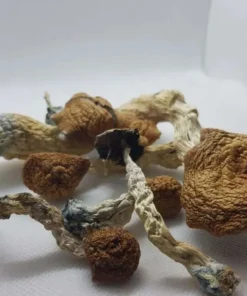
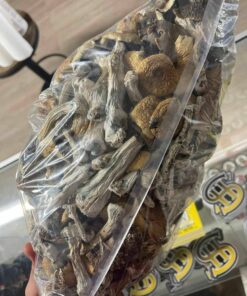
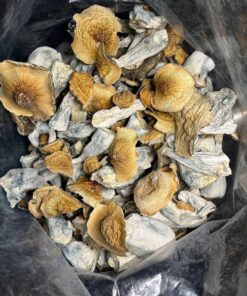
Psilocybin mushrooms are polyphyletic fungi containing the natural psychoactive prodrug psilocybin and its active metabolite psilocin.
| Species | Natural Habitat | Relative Potency | Key Characteristics |
| Psilocybe cubensis | Subtropical dung & soil | Moderate (Standard) | The most common, easily cultivated species (e.g., Golden Teacher, B+). |
| Psilocybe semilanceata | Moist grassy pastures | High | Known as the “Liberty Cap,” recognized by its distinct conical cap and nipple peak. |
| Psilocybe azurescens | Coastal dune woodchips | Extremely High | One of the most potent wild psilocybin species in North America. |
How Psilocybin Works in the Brain
When ingested, the body converts psilocybin into psilocin, which acts as a partial agonist on serotonin 5-HT2A receptors:
[Ingested Psilocybin] ──> Dephosphorylated in Liver/Gut ──> Psilocin ──> Crosses Blood-Brain Barrier ──> 5-HT2A Agonism
-
Default Mode Network (DMN) Quietness: Psilocin temporarily reduces activity in the brain’s Default Mode Network (associated with self-referential thought and ego processing), allowing for heightened neural cross-connectivity between previously unlinked brain regions.
-
Therapeutic Onset: Effects begin within 30 to 60 minutes, peak around 2 to 3 hours, and dissipate over 4 to 6 hours.
Clinical Research & Medical Applications
Clinical studies led by institutions such as Johns Hopkins University demonstrate psilocybin’s therapeutic potential:
-
Treatment-Resistant Depression (TRD): Breakthrough Therapy Designation by the FDA for rapid, lasting mood elevation.
-
End-of-Life Cancer Anxiety: Significantly decreases existential distress and depression in terminally ill patients.
-
Substance Addiction: High success rates in smoking cessation and alcohol use disorder trials when paired with therapy.
Harm Reduction & Critical Safety Precautions
-
Lethal Lookalikes: Never forage wild mushrooms without expert mycological verification. Lethal species like Amanita phalloides (Death Cap) or Galerina marginata (Funeral Bell) can be easily mistaken for edible or psychoactive varieties.
-
Psychiatric Screening: Avoid psilocybin if you have a personal or family history of schizophrenia, psychosis, or bipolar I disorder.
-
Physiological Tolerance: Psilocybin is non-addictive and does not cause physical withdrawal, but rapid cross-tolerance develops if used repeatedly within short timeframes.
Frequently Asked Questions
Are psilocybin mushrooms addictive?
No. Psilocybin mushrooms are non-addictive and do not cause compulsive drug-seeking behavior or physical dependency.
How are psilocybin mushrooms consumed?
Common methods include eating them dried, brewing them as a hot tea, blending them into food, or utilizing “Lemon Tek” (soaking ground mushrooms in citric juice to pre-convert psilocybin into psilocin).
What is the difference between psilocybin mushrooms and functional mushrooms?
Functional mushrooms (like Lion’s Mane or Reishi) are non-psychoactive and taken daily for immunity or focus. Psilocybin mushrooms contain psychoactive compounds that cause temporary alterations in perception and mood.